Last updated: September 2026
Bitwarden Review 2026: Is It Still One of the Best Password Managers?
Bitwarden has built its reputation around a rare combination of open-source transparency, strong encryption, a genuinely useful free tier, affordable premium plans, and broad cross-platform support.
In this review, we look beyond the marketing language and examine what Bitwarden actually offers in 2026: security architecture, encryption, independent audits, passkeys, autofill, Premium features, Families, emergency access, self-hosting, and everyday usability.
| Best for | Most users who want strong security, excellent value, open-source transparency, and support across many devices. |
|---|---|
| Free plan | Yes — unlimited passwords and unlimited devices. |
| Premium | $19.80/year at current official pricing. |
| Families | Up to 6 users, currently $47.88/year. |
| Encryption | AES-256-CBC with HMAC-SHA256 for vault data. |
| Architecture | Zero-knowledge, end-to-end encryption. |
| Open source | Yes. |
| Independent audits | Yes — regular third-party security assessments. |
Students, families, professionals, developers, businesses, and privacy-conscious users looking for a secure password manager without premium pricing.
Quick Navigation
What Is Bitwarden?
Bitwarden is a password manager that stores passwords, passkeys, secure notes, payment cards, identities, and other sensitive information inside an encrypted vault. The vault can then synchronize across supported browser, desktop, and mobile applications.
Instead of remembering a different complex password for every account, you remember one strong master password and let Bitwarden generate and store unique credentials for the individual websites and applications you use.
Why Password Managers Matter
Humans are not good at memorizing dozens of long, completely unique passwords. Without a password manager, people commonly compensate by reusing passwords, selecting predictable variations, or storing credentials in insecure places.
A password manager changes the model. The software can create and remember high-entropy passwords while you only need to protect your master password and Bitwarden account.
- Unique password for every important account.
- Built-in password and username generation.
- Autofill reduces manual typing.
- Passkey storage and use.
- Encrypted storage for notes, cards, and identities.
- Synchronization across devices.
Key Bitwarden Features
Unlimited Passwords
The free plan supports unlimited stored passwords rather than imposing a small vault limit.
Unlimited Devices
Use your vault across supported desktop, browser, and mobile clients.
Password Generator
Generate strong randomized passwords instead of creating predictable passwords manually.
Passkeys
Store and use passkeys for supported websites and services.
Autofill
Fill login information through supported browser extensions and mobile operating systems.
Bitwarden Send
Share encrypted text or files securely with another person.
Secure Notes
Store sensitive text that does not belong in a traditional username/password entry.
Email Alias Integration
Integrate supported email-forwarding services into the username generator.
Security & Encryption
Bitwarden's security model starts on your local device. Vault data is encrypted before it is transmitted to Bitwarden's servers. The server stores encrypted data rather than a readable copy of your vault.
AES-256-CBC + HMAC-SHA256
Bitwarden documents the use of AES with 256-bit keys in CBC mode for vault encryption, combined with HMAC-SHA256 to provide authentication and integrity.
Key derivation
Your master password is not used directly as the vault encryption key. A key derivation function transforms it into cryptographic material. Bitwarden supports PBKDF2 and Argon2id configurations.
Two-step login
Bitwarden supports multiple forms of two-step login. Depending on account type and configuration, these can include authenticator applications and hardware security keys.
Independent Audits & Open-Source Transparency
Bitwarden's open-source model is one of its strongest differentiators. Its code can be inspected publicly, which makes independent scrutiny easier than it is for completely closed-source password managers.
Bitwarden also commissions regular third-party security assessments covering areas such as its browser extension, core application, desktop application, web vault, mobile applications, cryptography, and network infrastructure.
Recent assessment work has included Cure53, Unit 42 by Palo Alto Networks, Fracture Labs, and an in-depth cryptography assessment from ETH Zurich's Applied Cryptography Group.
Why audits matter
No security audit can guarantee that software will never have a vulnerability. Repeated independent review is still valuable because it gives external experts an opportunity to examine implementation, identify weaknesses, and verify important security claims.
Privacy & Zero-Knowledge Architecture
Bitwarden describes itself as a zero-knowledge encrypted password manager. Vault encryption occurs locally, and Bitwarden says it does not possess the keys required to decrypt the contents of a properly secured vault.
This distinction is important. Your encrypted vault can be synchronized through cloud infrastructure without the server needing a plaintext copy of the passwords stored inside it.
Passkeys & Phishing Resistance
Bitwarden supports storing and using passkeys on compatible websites. Passkeys can improve resistance to traditional credential phishing because they rely on public-key cryptography rather than a shared secret that users type into arbitrary login forms.
Password managers can also reduce phishing risk during password-based logins because autofill is associated with the saved website domain. A fake domain does not automatically match the original saved login.
Bitwarden Web & Mobile App Interface
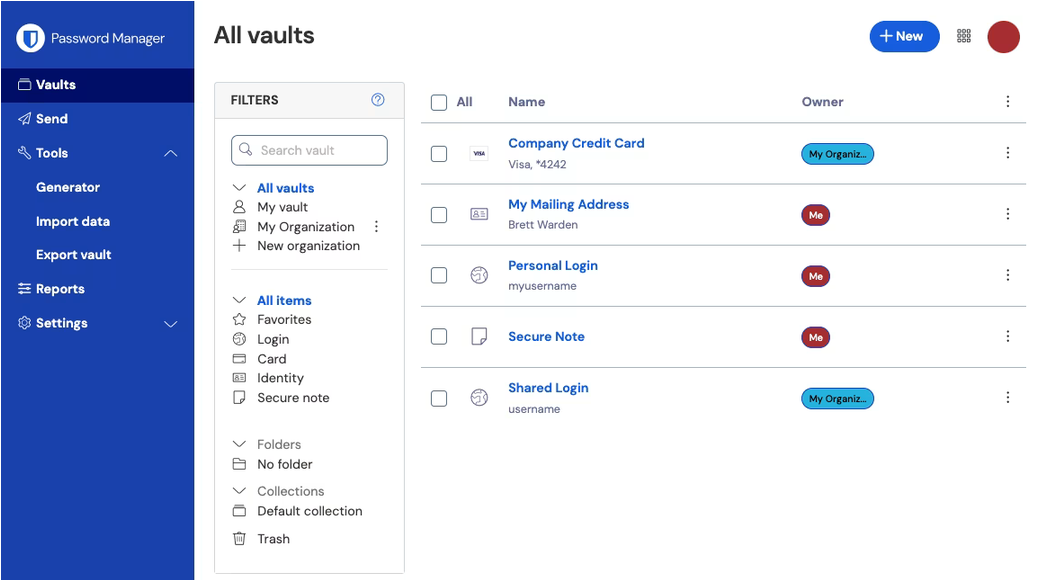
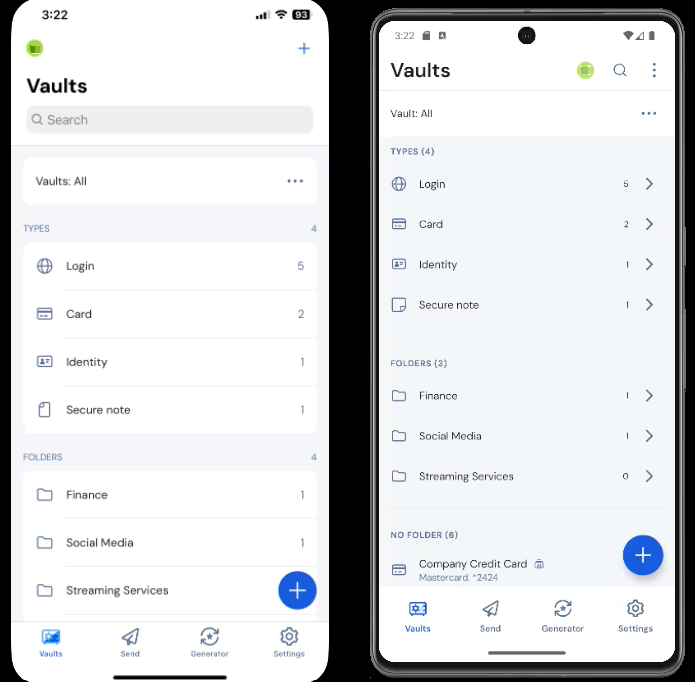
The web vault provides a larger workspace for organizing passwords and changing account settings, while the mobile app is designed for quick access, biometric unlock, and autofill while using apps and websites on a phone.
Performance & Everyday Ease of Use
Password-manager performance is less about benchmark numbers and more about whether the software stays out of the user's way. The important tasks are vault unlock, synchronization, search, password generation, and autofill.
Bitwarden's interface has traditionally prioritized function over visual luxury. That is a positive for users who want a direct, information-dense password manager, although some competitors provide a more polished onboarding experience.
Browser extensions
Browser extensions are central to the everyday experience. They provide quick access to saved logins, password generation, and autofill without requiring the web vault to remain open.
Mobile
On mobile, biometric unlock and operating-system autofill integration make Bitwarden substantially more convenient than manually copying passwords between applications.
Bitwarden Free vs Premium vs Families
Bitwarden remains unusually competitive because its free plan includes the core functionality many users actually need: unlimited passwords, unlimited devices, browser and mobile applications, passkey management, password generation, and encrypted vault storage.
| Feature | Free | Premium | Families |
|---|---|---|---|
| Unlimited passwords | Yes | Yes | Yes |
| Unlimited devices | Yes | Yes | Yes |
| Passkeys | Yes | Yes | Yes |
| Integrated authenticator | No | Yes | Yes |
| Emergency Access | No | Yes | Yes |
| Current annual price | $0 | $19.80 | $47.88 |
Premium
Premium currently costs $1.65 per month when billed annually at $19.80. It adds features such as the integrated authenticator, encrypted file attachments, Emergency Access, vault health reports, and priority support.
Families
The Families plan currently costs $3.99 per month when billed annually at $47.88 and covers up to six users. It includes six premium accounts and family sharing features.
Emergency Access
Emergency Access is a Premium feature that allows you to designate trusted Bitwarden users who may request access to your vault if an emergency occurs.
Bitwarden supports two emergency-access models: View, which provides read access after approval, and Takeover, which allows the emergency contact to assume permanent account access.
The account owner selects a waiting period. A request can be approved manually or become available after the configured waiting period if the owner does not reject it.
Self-Hosting
Bitwarden offers self-hosting options. This allows technically experienced users and organizations to run Bitwarden server components on infrastructure they control.
Self-hosting can provide more control over infrastructure and data location, but it also transfers significant operational responsibility to the person or organization managing the server.
Bitwarden Pros & Cons
Pros
- Excellent permanent free plan.
- Unlimited passwords and devices.
- Open-source codebase.
- Zero-knowledge encryption.
- Strong independent-audit history.
- Affordable Premium pricing.
- Passkey support.
- Emergency Access.
- Cross-platform support.
- Self-hosting available.
Cons
- Interface is more functional than luxurious.
- Some Premium tools require configuration.
- Self-hosting can create security problems if administered poorly.
- New users still need to understand master passwords and account recovery.
- Storing TOTP codes in the same vault is a convenience/security trade-off.
Who Should Use Bitwarden?
- Students: excellent core functionality without a paid subscription.
- Families: affordable sharing for up to six users.
- IT professionals and developers: open-source transparency and self-hosting options appeal to technical users.
- Privacy-conscious users: zero-knowledge architecture and public source code provide strong transparency.
- Businesses: Teams and Enterprise plans add centralized administration and business controls.
Bitwarden Alternatives
| Password Manager | Best for | Main difference |
|---|---|---|
| Bitwarden | Overall value | Open source + excellent free plan. |
| 1Password | Premium experience | Highly polished interface and family/business tools. |
| Proton Pass | Privacy ecosystem | Strong integration with Proton services. |
| NordPass | Simplicity | Straightforward interface and security ecosystem. |
| Dashlane | Security extras | Broader monitoring and security-related features. |
Frequently Asked Questions
Is Bitwarden safe?
Bitwarden uses zero-knowledge, end-to-end encryption, open-source software, strong cryptographic controls, two-step login options, and recurring third-party security assessments. No software is risk-free, but Bitwarden has a strong security model.
Is Bitwarden really free?
Yes. Bitwarden offers a permanent free personal account with unlimited passwords and unlimited devices. Paid tiers add premium features rather than removing core functionality.
Does Bitwarden know my passwords?
Bitwarden states that vault data is encrypted on your device before being sent to its servers. Under its zero-knowledge model, the service does not possess the keys needed to decrypt your vault contents.
Does Bitwarden support passkeys?
Yes. Passkey management and use are part of Bitwarden's current password-manager feature set.
Is Bitwarden Premium worth it?
For many people, yes. Premium is inexpensive and adds the integrated authenticator, encrypted attachments, Emergency Access, security reports, and priority support. The free tier is still sufficient for many individual users.
Can I self-host Bitwarden?
Yes. Bitwarden provides self-hosting options, but running your own server also makes you responsible for patching, availability, backups, and server security.
Final Verdict
Bitwarden remains one of the strongest all-round password managers in 2026. The free tier is unusually capable, Premium remains inexpensive, and the product combines open-source transparency with zero-knowledge encryption, passkeys, broad platform support, independent audits, and useful advanced features.
The interface may not feel as premium as some competitors, but that is a relatively small trade-off considering the security model and value.
For most people asking where to start with a password manager, Bitwarden is one of the easiest products to recommend.